Reading one of Vendredi's last text messages — sent at 11:21 PM on May 25, the night before she chose to take her life — left me in tears. Furious. Bewildered. (More from that text later on this page.)
And the reading of it led me here. To this page. To this warning.
How a Mentality Gets Built In
The original court order from when Vendredi was small gave me every other weekend, plus holidays and summer. From 2013 forward there were so many excuses, so much fighting, that I finally said: whenever she wants to see me, or you want me to see her, let me know. I stepped out of the war so my daughter would not have to live inside it. That is the gap in the pictures.
In 2018 I got a phone call. My daughter was acting out, I was told — because of me. We sat down with her mother's bishop. Visitation began again.
Then the excuses came back. Including, I will never forget, roller derby practice on Saturdays.
When I started fighting to actually get the court-ordered time I had on paper, her mother took me back to court — to raise child support I had already voluntarily raised more than once, and to claim my visits were causing Vendredi mental stress, and to claim Vendredi did not want to see me.
That fight ended differently than expected. Full custody came to me in 2020. Vendredi was fourteen.
The same posture has been pointed at me again the last three years, after she went back to her mother's home. She doesn't want to call you, Dad. She doesn't want to come. Her own counselor warned her mother that her disposition toward me had placed Vendredi in a position where she could not openly say she enjoyed time with her father.
I Have a Letter From When She Was Five
I have a letter dated April 26, 2013. Vendredi was five years old.
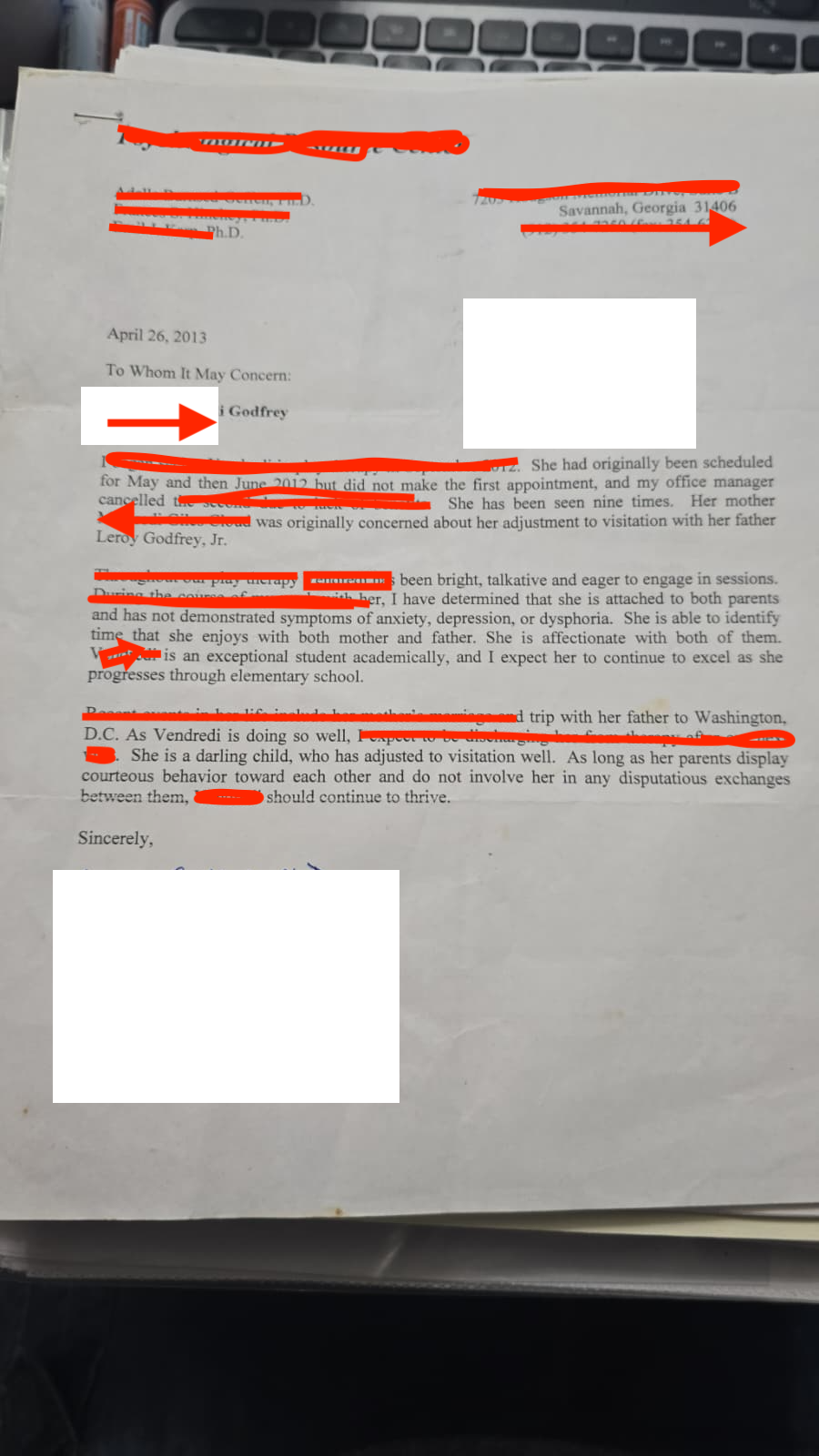
Her mother had taken her to a Ph.D. clinical psychologist, licensed in the State of Georgia and a member of the American Psychological Association, almost a year earlier — in May 2012 — with one stated concern: Vendredi's adjustment to visitation with her father.
That sentence is doing more work than it looks like. It tells you what the mother was trying to establish — that visitation with me was the problem. That is why a five-year-old was sitting in a psychologist's office.
But notice what came next. The first appointment her mother set up — May 2012 — was not kept. Her mother did not bring her. The second appointment, in June 2012, was canceled by the office over benefits. Therapy did not actually begin until September 2012. That is the timeline of a parent setting up a case. It is not the timeline of a parent in crisis about a child.
Across nine sessions, the doctor formed her own professional opinion of my daughter — and put it on letterhead, in writing, sent to me.
What the document said, in summary — paraphrased here out of respect for the confidentiality notice on the page:
- My daughter was attached to both parents.
- She was affectionate with both of us.
- She had no symptoms of anxiety, depression, or dysphoria.
- She was an exceptional student academically.
- She could readily identify time she enjoyed with her mother and time she enjoyed with her father.
- Recent life events — including a trip she had taken with me to Washington, D.C., and her mother's marriage — were named in the letter as part of a healthy childhood.
And then the letter closed with the line that has stayed with me for the years since. In substance: my daughter was a darling child who had adjusted to visitation well — and as long as her parents displayed courteous behavior toward each other and did not involve her in disputatious exchanges between them, she would continue to thrive.
That was the finding. From a trained professional with no skin in the fight between her mother and me. The visits her mother set up to limit my visitation ended in a letter that fully vindicated my visits, fully vindicated my role as her father, and warned the adults — both of us — that the conflict between us was the only real threat to my daughter's thriving.
Her mother could not control the outcome. She tried to use a system. The system, in that small office, told the truth: my daughter was healthy, loved on both sides, and at risk from only one thing — the war between us.
I did not weaponize that letter. I did not wave it in court. I tried, again and again over the years, to step out of the fight when staying in it would cost her more.
But I kept the letter. I have kept every page of every file from every battle over the years — they sit on my desk right now, a stack so tall it casts a shadow. Because when the day came that I needed to tell the truth on this site about what was done to my daughter, I wanted to be able to do it with the documents in my hand, and not from memory.

Fourteen years later, the same posture is still being pointed at her. The same script — she doesn't want to see him, she doesn't want to call him — is the one her own counselor recently warned her mother she was creating, by making it impossible for Vendredi to openly say otherwise.
From age five to age nineteen. Fourteen years of being placed in the middle of a war she did not start and could not end.
Fourteen years of being trained that her place in any house she entered was something she had to earn, perform, and quietly carry.
The Xbox That Was Not an Xbox
When custody was awarded to me in 2020, Vendredi was fourteen. She had only just become a full-time member of my household. She should have been doing fourteen-year-old things. School. Friends. Sleep. Eating my food without asking.
Instead, almost as soon as she settled in, she announced she was going to get a job.
We said no. She was a child. She had just come home. There was nothing she needed to earn.
But she pushed. She had her eye on an Xbox. She had her own number in her head — $500. She had clearly already done the math on what she thought she needed to put into the house.
My wife and I asked her where exactly a fourteen-year-old was going to find that kind of money. We made her stand down. We did not let her go look.
But the asking was the alarm. The fact that she came in at fourteen already believing she had to earn $500 — that was the alarm. I did not hear it the way I should have.
What I did not understand until much later was that the Xbox was not really the point. Somewhere in the years before she came back to me full-time — somewhere between every-other-weekend visits and being raised the rest of the time in another household — she had absorbed that her welcome in a home was conditional on her usefulness. That a child's place at the table was something paid for with money, labor, and not-being-too-much.
She was fourteen, and she was already trying to figure out how to help pay my mortgage.
I will live with that for the rest of my life. Not because I asked it of her — I did not. We told her no. But because the message that put her there was already inside her by the time I got her back full-time, and even at fourteen she was already trying to act on it. I did not see the depth of what had been built in. I just thought I had a daughter who liked the idea of working.
Children Were Not Designed to Carry Adult Weights
Children were not designed to carry adult weights. They will try. They will pretend. They will swallow the lie that they are "mature for their age" and take on what was never theirs to take. They will sometimes look like they are doing fine.
They are not.
And when they finally cannot carry it anymore, we are stunned — because they made it look like they could.
I do not want any other parent to be stunned the way I have been stunned. So I am going to name the weights. Look at this list. Look at it honestly. Then look at your child.
The Weights We Hand Them
- Financial weights Asking — or implying — that a child needs to contribute to rent, groceries, utilities, or the family budget. Letting them believe their welcome in the home is conditional on what they put into it. Talking about money problems in front of them so often that they take it on as their problem to solve.
- Differential weights — the weight of unequal welcome When one child in the household gets what they ask for and another is told later. When the biological child is supplied immediately and the step-child or returning-child is told we'll see. Children compare. Children count. The always-later child learns they belong to a different tier in the home. This weight is one of the cruelest and one of the most invisible — because the adult handing it out almost never thinks of it as anything more than scheduling. The child receiving it knows exactly what it means.
- Emotional weights Using your child as a confidant for adult problems. Venting about your spouse, your ex, your job, your parents to your child. Letting your bad days roll onto them. Expecting them to manage your mood so you can function.
- Caretaker weights Treating an older child like a backup parent for the younger ones. Expecting them to cook, clean, supervise, transport, and discipline siblings as a primary duty rather than an occasional help.
- Conflict weights Forcing them to choose sides between parents. Asking them to relay messages. Pumping them for information about the other house. Making them the witness or the referee to adult fights.
- Performance weights Demanding they be the perfect one. The easy one. The high-achiever who makes up for everything else falling apart. Letting their grades or behavior become the metric of your worth as a parent.
- Replacement weights After a divorce, a death, or a long absence, letting a child slide into the seat of the missing adult. Calling them the man of the house or my little partner. Asking them to fill emotional spaces that belong to another adult.
- Secret weights Asking them to keep family secrets. Asking them to keep up the family's image in public when something is wrong inside. Teaching them that appearance is more important than their honest experience.
- Invisible weights The ones we do not even know we are handing them. The disapproval that travels in our silences. The mood that arrives home with us from work. The thing we do not say but they feel anyway.
Why This Breaks Them
Children's brains are still being built. The wiring that will eventually let them carry adult weights — emotional regulation, judgment, perspective on long-term outcomes — does not finish developing until well into the twenties. When we hand them weights they are not yet wired for, they do not say I cannot carry this. They use their developing self to carry it anyway, at a cost we will not see until later.
What it costs them:
- A childhood. They lose the freedom to be carefree, foolish, dependent. They lose what only children get to have.
- Their sense of unconditional welcome. They begin to believe they have to earn love through usefulness, performance, or silence.
- Their honest interior. They learn to perform okay-ness so they do not add to your weight. The performance becomes the prison.
- The capacity to ask for help. If they were raised to be the help, they do not know how to ask for it.
And then sometimes they hit a wall. Not because of one thing. Because of the cumulative weight of the carrying.
What That Last Text Said
Earlier I opened this page with a reference to one of Vendredi's last text messages. Here is what I meant.
That night she had told her friend she was tired — tired in the way that asks a friend to ask a second question. Her friend asked. And what came back, sent at 11:21 PM on May 25, was not a teenager's complaint. It was the inventory of a grown woman's load.
 Sent to a close friend at 11:21 PM on May 25, 2026. The friend's identifying information has been removed to protect her privacy. Shared with the family's blessing.
She had been carrying that list since she was a small child. Different items at five, eight, twelve, fourteen, nineteen — but always the same shape of weight. A child in adult armor. By the night she ran out of strength, even her closest people thought she was simply someone who kept up.
The trick of a child trained to carry adult weight is exactly that.
It does not look like distress. It looks like competence.
What to Do Instead
If any of the weights named above sounded familiar in your own household, hear this: it is not too late. Children are remarkably forgiving. But you have to put the weight back on yourself.
On money
Your child is not a contributor to the rent. The end. They can have a job because they want spending money or work experience. They cannot have a job because the family budget needs it. If money is tight, the conversation about it is between adults, not at the dinner table where the child is listening.
On differential treatment
If one child in your household consistently gets yes and another consistently gets later — your other child has noticed. Audit yourself honestly. Step-child, biological child, returning child, full-time child, every-other-weekend child — every child in the home should know they belong to the same tier of welcome. If they don't, fix it. Then say out loud that you are fixing it.
On venting
Your child is not your therapist. Pick an adult.
On siblings
Your older child is not the backup parent. If they help, it is help. It is not a job description.
On conflict
Your child does not relay messages between parents. They are not the bridge. They are the people the bridge is supposed to be built for.
On performance
Tell them out loud — frequently — that your love is not conditional on their grades, their behavior, their easy-ness. They need to hear it more often than you think.
On replacement
Your child is not the man of the house. They are not your little partner. They are your child. Find adult company for adult roles.
On secrets
If the family has a problem, that problem does not belong inside your child. Get help. Tell the truth. Let them be honest about what they see.
On the invisible weights
Notice your own mood when you walk in the door. Notice what your silences are teaching. The smallest weights add up.
A Closing Word
If you read this and recognize your own household, do not collapse into guilt. The point is not for you to carry one more weight — the weight of your own failure. The point is to put the weights that belong on you back on you, where they belong, starting today.
If you read this and recognize a child you love is still carrying weights they were never built to carry — say it out loud:
I see what you are carrying. It is not yours. Put it down.
Some children, when they hear that for the first time, finally take a breath that has been waiting years.
Vendredi did not get to hear that often enough or early enough. I am writing this page so that some other child does.